Welcome to WordPress. This is your first post. Edit or delete it, then start writing!
Blog
-
Atoms and Molecules
Atoms and Molecules explained in simple terms for students and learners of all ages.
]]> -
States of Matter
States of Matter explained in simple terms for students and learners of all ages.
]]> -
What is Force?
What is Force? explained in simple terms for students and learners of all ages.
]]> -
Laws of Motion
Laws of Motion explained in simple terms for students and learners of all ages.
]]> -
PHP Exercises, Practice, Solution
What is PHP?
PHP (recursive acronym for PHP: Hypertext Preprocessor) is a widely-used open source general-purpose scripting language that is especially suited for web development and can be embedded into HTML.
The best way we learn anything is by practice and exercise questions. We have started this section for those (beginner to intermediate) who are familiar with PHP.
Hope, these exercises help you to improve your PHP coding skills. Currently, following sections are available, we are working hard to add more exercises. Happy Coding!
Note: It’s fine if you are playing around with PHP codes with the help of an online PHP editor, to enjoy a full-fledged PHP environment (since online editors have several caveats, e.g. embedding PHP within HTML) up and running on your own machine is much better of an option to learn PHP. Please read our installing PHP on Windows and Linux if you are unfamiliar to PHP installation.
List of PHP Exercises :
- PHP Basic : 102 Exercises with Solution
- PHP Basic Algorithm: 136 Exercises with Solution
- PHP Error and Exception Handling [ 10 exercises with solution ]
- PHP File Handling [ 18 exercises with solution ]
- PHP Cookies and Sessions Exercises Practice Solution [ 16 exercises with solution ]
- PHP OOP Exercises Practice Solution [ 19 exercises with solution ]
- PHP arrays : 59 Exercises with Solution
- PHP for loop : 38 Exercises with Solution
- PHP functions : 6 Exercises with Solution
- PHP classes : 7 Exercises with Solution
- PHP Regular Expression : 7 Exercises with Solution
- PHP Date : 28 Exercises with Solution
- PHP String : 26 Exercises with Solution
- PHP Math : 12 Exercises with Solution
- PHP JSON : 4 Exercises with Solution
- PHP Searching and Sorting Algorithm : 17 Exercises with Solution
- More to Come !
PHP Challenges :
- PHP Challenges: Part -1 [ 1- 25]
- More to come
Note : You may accomplish the same task (solution of the exercises) in various ways, therefore the ways described here are not the only ways to do stuff. Rather, it would be great, if this helps you anyway to choose your own methods.
[ Want to contribute to PHP exercises? Send your code (attached with a .zip file) to us at w3resource[at]yahoo[dot]com. Please avoid copyrighted materials.]
List of Exercises with Solutions :
- HTML CSS Exercises, Practice, Solution
- JavaScript Exercises, Practice, Solution
- jQuery Exercises, Practice, Solution
- jQuery-UI Exercises, Practice, Solution
- CoffeeScript Exercises, Practice, Solution
- Twitter Bootstrap Exercises, Practice, Solution
- C Programming Exercises, Practice, Solution
- C# Sharp Programming Exercises, Practice, Solution
- PHP Exercises, Practice, Solution
- Python Exercises, Practice, Solution
- Java Exercises, Practice, Solution
- SQL Exercises, Practice, Solution
- MySQL Exercises, Practice, Solution
- PostgreSQL Exercises, Practice, Solution
- SQLite Exercises, Practice, Solution
- MongoDB Exercises, Practice, Solution
-
PHP error handling
Description
PHP has a number of functions for handling as well as reporting errors. Besides, you can define your own way of handling and reporting errors. In this and subsequent pages we are going to discuss installation, runtime configuration, predefined constants and functions relating to PHP error handling and reporting.
Installation and configuration
In PHP 5, you don’t need any external library, and you don’t need any installation in addition to error handling and reporting.
Configuration settings for PHP Error handling and reporting are available in php.ini file, which is located in the php installation folder of your system.
Following is a list of error handling settings, there descriptions, default value and where they can be changed (Changeable).
For reference, settings of any PHP configuration can be changed in various ways – using ini_set(), in WINDOWS registry, in php.ini, in .htaccess or in httpd.conf. PHP_INI_ALL refers that the related configuration can be changed in any the aforementioned ways. PHP_INI_SYSTEM refers the entry can be set in php.ini or httpd.conf.
Name Type Description Default Changeable error_reporting integer Set the error reporting level. NULL PHP_INI_ALL display_errors string Determines if errors are displayed or hidden. “1” PHP_INI_ALL display_startup_errors boolean Even if display_errors is on, hides errors that occur during PHP’s startup sequence. Keep it off when online. “0” PHP_INI_ALL log_errors boolean Specifies if script error messages should be logged to the server’s error log. “0” PHP_INI_ALL log_errors_max_len integer Specifies the maximum length of log_errors in bytes. “1024” PHP_INI_ALL ignore_repeated_errors boolean Do not log repeated messages. “0” PHP_INI_ALL ignore_repeated_source boolean Ignore source of message when ignoring repeated messages. “0” PHP_INI_ALL report_memleaks boolean If set to Off, memory leaks (the program is unable to release memory it has occupied) will not be displayed. “1” PHP_INI_ALL track_errors boolean If enabled, variable $php_errormsg will always hold the last error message. “0” PHP_INI_ALL html_errors boolean Turns HTML tags off in error messages. “1” PHP_INI_ALL xmlrpc_errors boolean Formats errors as XML-RPC error message, turning normal error reporting off. “0” PHP_INI_SYSTEM xmlrpc_error_number integer Used as the value of the XML-RPC fault Code element. “0” PHP_INI_ALL docref_root string Format of a new error which contains a reference to a page describing the error or function causing the error. “” PHP_INI_ALL docref_ext string Specifies the file extension of the reference page (as mentioned in docref_root). “” PHP_INI_ALL error_prepend_string string String to output before an error message. NULL PHP_INI_ALL error_append_string string String to output after an error message. NULL PHP_INI_ALL error_log string Name of the file where script errors should be logged. NULL PHP_INI_ALL PHP error handling – predefined constants
DescriptionList of predefined constants used in PHP 5 for error handling.
Predefined constants
Here is a list of the predefined constants used in PHP 5 for error handling :
Name Type Description value E_ERROR integer Execution of the script comes to a halt. An example is memory allocation problem. 1 E_WARNING integer Execution of the script is not halted, warnings generated. 2 E_PARSE integer Parse errors generated by parsers during compilation. 4 E_NOTICE integer Run-time notices which indicated that may be an error took place but may also be a normal course of action. 8 E_CORE_ERROR integer Fatal errors that occur during the initial startup of PHP. 16 E_CORE_WARNING integer Warnings (execution of the script is not halted) that occur during PHP’s initial startup. 32 E_COMPILE_ERROR integer Fatal compile-time errors. 64 E_COMPILE_WARNING integer Compile-time warnings, execution of the script is not halted. 128 E_USER_ERROR integer User-generated error message. 256 E_USER_WARNING integer User-generated warning message. 512 E_USER_NOTICE integer Same as E_NOTICE. The only difference is, trigger_error() function is used here to generate the error message. 1024 E_STRICT integer User-generated notice message. 2048 E_RECOVERABLE_ERROR integer Catchable fatal error. 4096 E_DEPRECATED integer Run-time notices. 8192 E_USER_DEPRECATED integer User-generated warning message. 16384 E_ALL integer All errors and warnings, as supported. Exception level E_STRICT. 30719 All these constants are available in php.ini of your PHP installation folder.
-
Cookies in PHP
What is a cookie
Cookies are used to store the information of a web page in a remote browser, so that when the same user comes back to that page, that information can be retrieved from the browser itself.
In this tutorial, we will discuss how to use Cookies in PHP. We have several examples in this tutorial which will help you to understand the concept and use of a cookie.
Uses of cookie
Cookies are often used to perform following tasks:
- Session management: Cookies are widely used to manage user sessions. For example, when you use an online shopping cart, you keep adding items in the cart and finally when you checkout, all of those items are added to the list of items you have purchased. This can be achieved using cookies.
- User identification: Once a user visits a webpage, using cookies, that user can be remembered. And later on, depending upon the search/visit pattern of the user, content which the user likely to be visited are served. A good example of this is ‘Retargetting’. A concept used in online marketing, where depending upon the user’s choice of content, advertisements of the relevant product, which the user may buy, are served.
- Tracking / Analytics: Cookies are used to track the user. Which, in turn, is used to analyze and serve various kind of data of great value, like location, technologies (e.g. browser, OS) form where the user visited, how long (s)he stayed on various pages etc.
How to create a cookie in PHP
PHP has a
setcookie()function to send a cookie. We will discuss this function in detail now.Usage:
setcookie(name, value, expire, path, domain, secure, httponly)Copy
Parameters:
setcookie() has several parameters. Following table discusses those.
Parameter Description Which type of data name Name of the cookie. String value Value of the cookie, stored in clients computer. String expire Unix timestamp, i.e. number of seconds since January 1st, 1970 (called as Unix Epoch). Integer path Server path in which the cookie will be available. String domain To which domain the cookie is available. String secure If set true, the cookie is available over a secure connection only. Boolean httponly If set true, the cookie is available over HTTP protocol only. Scripting languages like JavaScript won’t be able to access the cookie. Boolean setcookie()returns boolean.Example:
Following example shows how to create a cookie in PHP. Code first and then some explanation.
<?php
$cookie_value = "w3resource tutorials";
setcookie("w3resource", $cookie_value, time()+3600, "/home/your_usename/", "example.com", 1, 1);
if (isset($_COOKIE['cookie']))
echo $_COOKIE["w3resource"];
?>
Copy
So, what does the code above does? The first parameter sets the name of the cookie as ‘w3resource’, the second parameter sets the value as ‘w3resource tutorials’, the third parameter states that the cookie will be expired after 3600 seconds (note the way it has been declared, we use time() and then add the number of seconds we wish the cookie must be expired after), the fourth parameter sets path on the server ‘/home/your_name’ where your_name may be an username, so it directs the home directory of a user, the fifth and sixth parameter is set to 1, i.e. true, so the cookie is available over secure connections only and it is available on HTTP protocol only.
echo $_COOKIE["w3resource"];simply prints the cookie value. This way you can retrieve a cookie value.Output:
w3resource tutorials
How to create a cookie without urlencoding the cookie value
The
setcookie()sends a cookie by urlencoding the cookie value. If you want to send a cookie without urlencoding the cookie value, you have to usesetrawcookie().This function has all the parameters which setcookie() has, and the return value is also boolean.
PHP $_COOKIE autoglobal
If a cookie is successfully sent to you from the client, it is available in $_COOKIE, which is automatically global in PHP, if the variables_order directive in php.ini is set to C.
The following code shows how to use $_COOKIE.
<?php
$cookie_value = "w3resource tutorials";
setcookie("w3resource", $cookie_value, time()+3600, "/home/your_usename/", "example.com", 1, 1);
echo 'Hi ' . htmlspecialchars($_COOKIE["w3resource"]);
?>
Copy
If you wish to retreive all the cookies, you may use the following command
<?php
print_r($_COOKIE);
?>
Copy
headers already sent problem because of cookies
PHP Cookies are part of the HTTP header. Therefore, in a PHP script, if it is not set before any another output is sent to the browser, you will get a warning like “…headers already sent….”.
To get rid of the problem, you may use “Output buffering functions”. Following code shows how to add an output buffering function.
<?php
ob_start(); //at the begining of the php script
//your code goes here
//add these two lines at the end of the script
$stuff = ob_get_clean();
echo $stuff;
?>
Copy
How to delete a cookie
To delete a cookie value, you may set the expiry time of the cookie in the past. In the following code snippet, cookie expiry time is set one hour before.
<?php
$cookie_value = "w3resource tutorials";
setcookie("w3resource", $cookie_value, time()-3600, "/home/your_usename/", "example.com", 1, 1);
?>
Copy
Javascript cookies vs php cookies
This may confuse you if you are just starting out with web programming. But in practice, Cookies are defined by RFC 2965. It is a standard which can be used any programming language. It has nothing to do with PHP vs JavaScript. In PHP, as we have seen in the first example of this tutorial, that cookies can be set such a way that it can’t be accessed by client side JavaScript, but that is a programming feature only.
Cookies vs Sessions
Both cookies and sessions are used for storing persistent data. But there are differences for sure.
Sessions are stored on server side. Cookies are on the client side.
Sessions are closed when the user closes his browser. For cookies, you can set time that when it will be expired.
Sessions are safe that cookies. Because, since stored on client’s computer, there are ways to modify or manipulate cookies.
Hopefully, this tutorial about PHP cookies is useful for you. Let us know if you have questions or suggestions.
-
File upload in PHP
Description
In this page, we will discuss how file uploading is performed using PHP. For uploading files using PHP, we need to perform following tasks –
1. Set up an html page with a form using which we will upload the file.
2. Setup a PHP script to upload the file to the server as well as move the file to it’s destination.
3. Inform the user whether the upload was successful or not.Code :
<html>
<body>
<form action="upload_file.php" method="post" enctype="multipart/form-data">
<label for="file">Filename:</label>
<input type="file" name="file" id="file" size="20" /><br />
<input type="submit" name="submit" value="Submit" />
</form>
</body>
</html>
<?php
if (file_exists("upload/" . $_FILES["file"]["name"]))
{
echo $_FILES["file"]["name"] . " already exists. ";
}
else
{
move_uploaded_file($_FILES["file"]["tmp_name"],"upload/" . $_FILES["file"]["name"]);
echo "Stored in: " . "upload/" . $_FILES["file"]["name"];
}
?>
Copy
Explanation
Code Explanation: $_FILES[“uploaded_file”][“name”] The original name of the file uploaded from the user’s machine. $_FILES[“uploaded_file”][“type”] The MIME type of the uploaded file. You can use different types for test files, images and video. $_FILES[“uploaded_file”][“size”] The size of the uploaded file in bytes. $_FILES[“uploaded_file”][“tmp_name”] The location in which the file is temporarily stored on the server. $_FILES[“uploaded_file”][“error”] An error code if the file upload fails.
This way you can upload files to a web server. We encourage you to copy the codes above and try it on your computer or a web server.
-
PHP mail function
Description
The mail() function is used to send a mail.
Version:
(PHP 4 and above)
Syntax:mail(to, subject, message, extra headers, additional parameters)
Parameter:
Name Description Required /
OptionalType to Mail address to which you want to send mail Required String subject Subject of the mail Required String message Message to be sent with the mail. Each line of the message should be separated with a LF (\n). Lines should not be larger than 70 characters. Required String extra headers Additional headers like from, CC, BCC. If more than one additional headers are used, they must be separated with CRLF (Carriage return line feed), i.e. new line. Optional string additional parameters Additional parameters like – the envelope sender address when using sendmail with the -f sendmail option, can be used using this parameter. Optional string Return value:
Returns true if the mail is successfully sent, otherwise, it returns false.
Value Type: boolean
Example:
<?php
$to  = '[email protected]';
$subject = 'Demo mail ';
$message = 'This is a demo mail. Please reply to make sure the mail communication is okay.';
mail($to, $subject, $message);
?>
Copy
Send a simple mail using mail() function
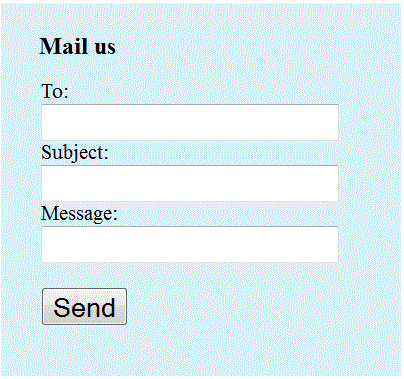
Browse view of the form for sending simple mail in php
Code:
<!DOCTYPE html PUBLIC "-//W3C//DTD XHTML 1.0 Transitional//EN" "http://www.w3.org/TR/xhtml1/DTD/xhtml1-transitional.dtd"> <html xmlns="http://www.w3.org/1999/xhtml"><head> <meta content="text/html; charset=ISO-8859-1" http-equiv="content-type" /><title>send mail in php</title> <style type="text/css"> li {list-style-type: none; font-size: 16pt; } .mail { margin: auto; padding-top: 10px; padding-bottom: 10px; width: 400px; background : #D8F1F8; border: 1px solid silver; } .mail h2 { margin-left: 38px; } input { font-size: 20pt; } input:focus, textarea:focus{ background-color: lightyellow; } input submit { font-size: 12pt; } </style> </head> <body> <div class="mail"> <h2>Mail us</h2> <ul> <li><form name="mail" method="POST" action="send.php"></li> <li>To:</li> <li><input type="text" name="to" /></li> <li>Subject:</li> <li><input type="text" name="subject" /></li> <li>Message:</li> <li><input type="text" name="Message" /></li> <li> </li> <li><input type="submit" name="submit" value="Send"/></li> <li> </li> </form> </ul> </div> </body></html>Copy
Code of the file for handling form (code above) data :
<?php
$to = $_POST['to'] ;
$message = $_POST['Message'] ;
mail( $to, "Mail", $message,  );
header( "Location: http://localhost/php/simple-mail.php" );
?>
Copy
Send mail with extra headers using mail() function
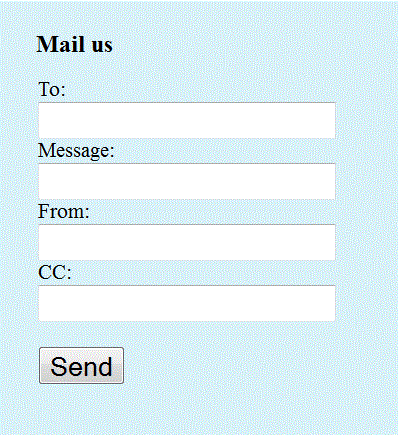
Browser view of the form for sending mail with extra headers in php
Code:
<!DOCTYPE html PUBLIC "-//W3C//DTD XHTML 1.0 Transitional//EN" "http://www.w3.org/TR/xhtml1/DTD/xhtml1-transitional.dtd"> <html xmlns="http://www.w3.org/1999/xhtml"><head> <meta content="text/html; charset=ISO-8859-1" http-equiv="content-type" /><title>send mail in php</title> <style type="text/css"> li {list-style-type: none; font-size: 16pt; } .mail { margin: auto; padding-top: 10px; padding-bottom: 10px; width: 400px; background : #D8F1F8; border: 1px solid silver; } .mail h2 { margin-left: 38px; } input { font-size: 20pt;< } input:focus, textarea:focus{ background-color: lightyellow; } input submit { font-size: 12pt; } </style> </head> <body> <div class="mail"> <h2>Mail us</h2> <ul> <li><form name="mail" method="POST" action="send-extra.php"></li> <li>To:</li> <li><input type="text" name="to" /></li> <li>Message:</li> <li><input type="text" name="Message" /></li> <li>From:</li> <li><input type="text" name="from" /></li> <li>CC:</li> <li><input type="text" name="cc" /></li> <li> </li> <li><input type="submit" name="submit" value="Send"/></li> <li> </li> </form> </ul> </div> </body></html>Copy
Code of the file for handling form (code above) data:
<?php
  $to = $_POST['to'] ;
  $message = $_POST['Message'] ;
  $from = $_POST['from'];
  $cc = $_POST['cc'];
  $headers =  "From: ".$_POST['from']."\r\n" .
"CC: ".$_POST['cc'];
  mail( $to, "Mail", $message, $headers);
  header( "Location: http://localhost/php/simple-mail.php" );
?>
Copy
We encourage you to replace the value of the parameters used in the above example and test it.
Send mail in PHP with additional parameters
You can pass additional parameters as command line options to the program configured to be used while sending mail. Those said configurations are defined by the sendmail_path configuration. One example of using additional parameter is setting the envelope sender address with -f option.
<?php
mail('[email protected]', 'Demo mail', 'Testing mail communication', null,
   '-f [email protected]');
?>
Copy
We encourage you to replace the value of the parameters used in the above example and with your’s and test it.